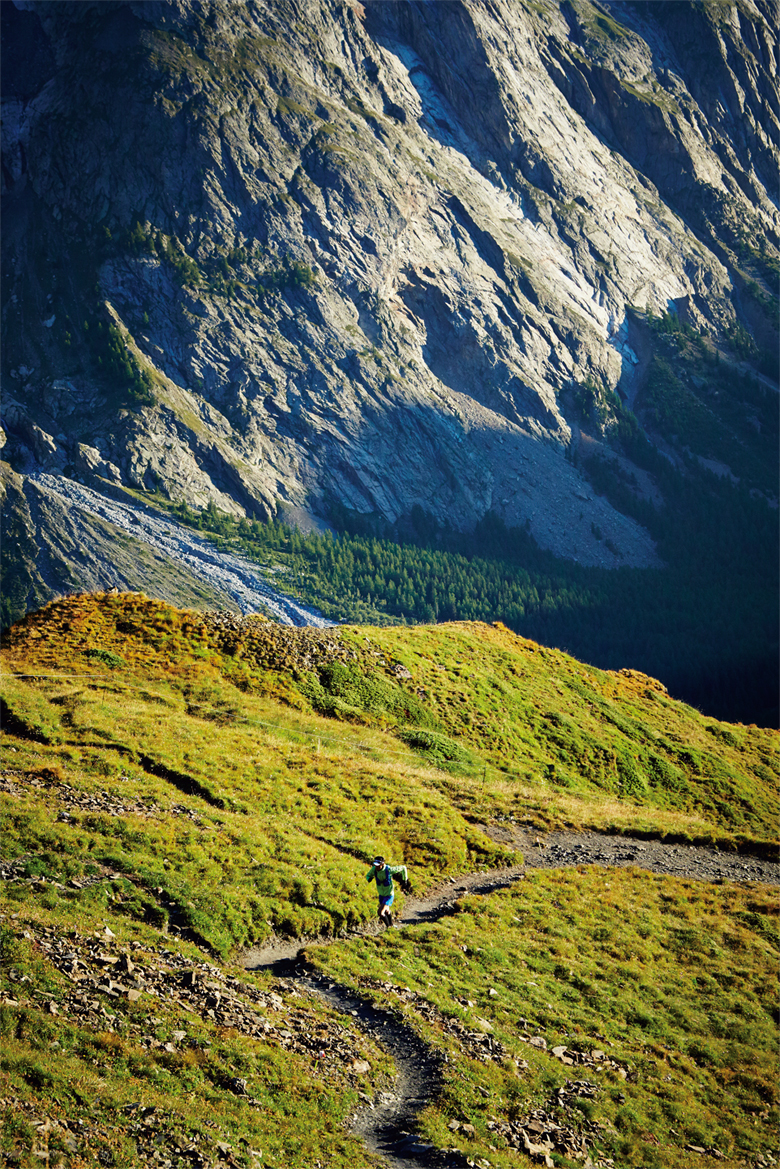
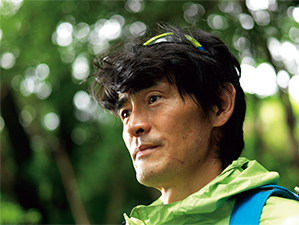
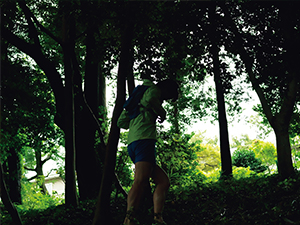
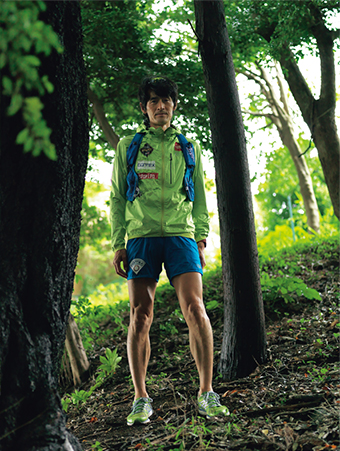






トレイルランナー鏑木毅が、いかに驚異的なことを為しているのか、常人にはなかなか理解し得ない。具体的な数字を上げれば分かるだろうか? 今年7月のコロラドのレース※1では100マイル、つまり約160kmを28時間かけて走ってきたばかり。しかも平均標高が3500mというかなりの高所。レース中に、富士山の5号目と山頂を7度も往復する計算になる。体脂肪率は、5%。鏑木さんは、トレランというスポーツの黎明期、18年前から山の中を走っている。
「この間、東北に行った時に、夕方の4時くらいから岩手山を登り始めたんです。普通なら頂上まで4時間くらいかかるんですが、僕は1時間くらいで行っちゃったんです。普通の人が丸一日かかるルートを往復で2時間ちょっと。するとどういうことが起こるかというと、劇的に環境が変化するんです。1時間で1200mという標高の変化もそうですし、サンセットをめがけて行ったので、景色もどんどん変わる。その展開の早さ、濃密さに病み付きになるんですよ。山の空気感は五感で感じるものなので、早いスピードの移動でも十二分に得られる。むしろ、山への向かい方が劇的になる分、普段見えないものが見えてくると思ってます。もちろん自分自身も常にテンションを上げていかなければ危ない部分もあって、それもすごく心地いい」
100マイルという長いレースの場合、身体はもちろんのこと、メンタルのコントロールが完走の決め手になるのではないか。どれほどの強い心があれば、丸一日以上、まったく眠らずに走り続けることができるのか。
「もうあり得ないくらい身体が動かないし、絶えず酸欠状態。でも、それもひっくるめて面白いって思うことが重要なんですよね、100マイルレースの場合には。痛かったり、だるかったりしたときに、ネガティブに考えると次のエイドでやめようとか、もうダメだって悪いことばかり考えるんだけど、その状態そのものをあり得ない面白い体験をしているじゃん、俺! ってスイッチの入れ方を変えるんです。それはある種の積み重ねてきた自信でもあるんだけど、何度か経験するうちに、そう思い込めるようになってくる。ひたすらポジティブのボリュームを上げていくんです。苦しさって右肩上がりではなくて、ふっと抜ける瞬間があるから、その時まで耐えて、自分を騙すんです。でもメンタルって面白くて、皇居をぐるぐる回っても160kmの距離は取れるんですけど僕には多分無理です。じゃあなぜトレイルランニングならできるのかと言えば、やっぱり山だから。山の持っている力っていうか。次のピークを見てみたいとか、自分の踏んでいるトレイルがどう展開していくのか、苦しいけどそれが支えになってくれるんです」
両親の影響で、小学生で富士山や北アルプスへ登る。その後、陸上競技へとのめり込んで箱根駅伝を目指していた鏑木さんは、しかし大学卒業と共に走ることの情熱を失ってしまう。体重80kgにまでなってしまったある日、ふと目にした新聞で地元の山岳レースの存在を知る。サラリーマンとして平日は働きながら、土日の休みを朝から晩まで走る日々。「登山では2泊3日のルートを、日帰りで行けるんですから」。面白くて面白くて堪らなかった。周囲からは奇異の目で見られながらも、レースでも普段の走りでも、ただひたすら「楽しかった」。こんなに面白いスポーツは、絶対に好きになる人が増えるんじゃないか、そう確信していたという。
「レースに出ることが目的ではなくて、サーフィンでもスキーでもそうですけど、それ自体が面白いからやっているっていうのが、アウトドアスポーツの健全なカタチだと思うんです。今ではレースしか出ないっていう人も増えているみたいですが、もったいない。本当の楽しみは、山地図を持って、このルートはどうなっているんだろう? っていうのが本当の楽しみ方だと思うんですよ。装備を考えたり、どうやって補給すればいいのか試したり、その試行錯誤が自分を成長させてくれたわけだから。地方に行ったら、トレランスタイルで山を登ってみる。それをやり始めたら、一般的な登山よりも奥が深いんじゃないかとさえ思います。なぜなら、常に自分の状態と高いレベルで向き合う必要があるから。登山と同じように、安全は自分できちんと確保するもの。トレイルランニングは、一秒でも早い人が絶対的にすごいっていう価値観にしたくない。僕は山のマラソンにしたくないんです。陸上競技とは違う世界を求めて、僕は山を走っているから」
では、その世界観とはどんなものか。レースである以上、順位は決まるが、共に走る競技者は、ある意味では互いの生存を確保するための同士でもある。極限の状態で走り続けることは、自分との強烈な対話だと、鏑木さんは言う。
「普段の走りでは、下山のため体力に余裕を持たせているけれど、レースではいわば安全を保証された状態なんですね。つまり、ギリギリの状態で山を走ることができるんです。そんな山ってあり得ないし、絶対にあってはいけない。でも、レースではボロボロの状態で、稜線を走るんです。
「この間、東北に行った時に、夕方の4時くらいから岩手山を登り始めたんです。普通なら頂上まで4時間くらいかかるんですが、僕は1時間くらいで行っちゃったんです。普通の人が丸一日かかるルートを往復で2時間ちょっと。するとどういうことが起こるかというと、劇的に環境が変化するんです。1時間で1200mという標高の変化もそうですし、サンセットをめがけて行ったので、景色もどんどん変わる。その展開の早さ、濃密さに病み付きになるんですよ。山の空気感は五感で感じるものなので、早いスピードの移動でも十二分に得られる。むしろ、山への向かい方が劇的になる分、普段見えないものが見えてくると思ってます。もちろん自分自身も常にテンションを上げていかなければ危ない部分もあって、それもすごく心地いい」
100マイルという長いレースの場合、身体はもちろんのこと、メンタルのコントロールが完走の決め手になるのではないか。どれほどの強い心があれば、丸一日以上、まったく眠らずに走り続けることができるのか。
「もうあり得ないくらい身体が動かないし、絶えず酸欠状態。でも、それもひっくるめて面白いって思うことが重要なんですよね、100マイルレースの場合には。痛かったり、だるかったりしたときに、ネガティブに考えると次のエイドでやめようとか、もうダメだって悪いことばかり考えるんだけど、その状態そのものをあり得ない面白い体験をしているじゃん、俺! ってスイッチの入れ方を変えるんです。それはある種の積み重ねてきた自信でもあるんだけど、何度か経験するうちに、そう思い込めるようになってくる。ひたすらポジティブのボリュームを上げていくんです。苦しさって右肩上がりではなくて、ふっと抜ける瞬間があるから、その時まで耐えて、自分を騙すんです。でもメンタルって面白くて、皇居をぐるぐる回っても160kmの距離は取れるんですけど僕には多分無理です。じゃあなぜトレイルランニングならできるのかと言えば、やっぱり山だから。山の持っている力っていうか。次のピークを見てみたいとか、自分の踏んでいるトレイルがどう展開していくのか、苦しいけどそれが支えになってくれるんです」
両親の影響で、小学生で富士山や北アルプスへ登る。その後、陸上競技へとのめり込んで箱根駅伝を目指していた鏑木さんは、しかし大学卒業と共に走ることの情熱を失ってしまう。体重80kgにまでなってしまったある日、ふと目にした新聞で地元の山岳レースの存在を知る。サラリーマンとして平日は働きながら、土日の休みを朝から晩まで走る日々。「登山では2泊3日のルートを、日帰りで行けるんですから」。面白くて面白くて堪らなかった。周囲からは奇異の目で見られながらも、レースでも普段の走りでも、ただひたすら「楽しかった」。こんなに面白いスポーツは、絶対に好きになる人が増えるんじゃないか、そう確信していたという。
「レースに出ることが目的ではなくて、サーフィンでもスキーでもそうですけど、それ自体が面白いからやっているっていうのが、アウトドアスポーツの健全なカタチだと思うんです。今ではレースしか出ないっていう人も増えているみたいですが、もったいない。本当の楽しみは、山地図を持って、このルートはどうなっているんだろう? っていうのが本当の楽しみ方だと思うんですよ。装備を考えたり、どうやって補給すればいいのか試したり、その試行錯誤が自分を成長させてくれたわけだから。地方に行ったら、トレランスタイルで山を登ってみる。それをやり始めたら、一般的な登山よりも奥が深いんじゃないかとさえ思います。なぜなら、常に自分の状態と高いレベルで向き合う必要があるから。登山と同じように、安全は自分できちんと確保するもの。トレイルランニングは、一秒でも早い人が絶対的にすごいっていう価値観にしたくない。僕は山のマラソンにしたくないんです。陸上競技とは違う世界を求めて、僕は山を走っているから」
では、その世界観とはどんなものか。レースである以上、順位は決まるが、共に走る競技者は、ある意味では互いの生存を確保するための同士でもある。極限の状態で走り続けることは、自分との強烈な対話だと、鏑木さんは言う。
「普段の走りでは、下山のため体力に余裕を持たせているけれど、レースではいわば安全を保証された状態なんですね。つまり、ギリギリの状態で山を走ることができるんです。そんな山ってあり得ないし、絶対にあってはいけない。でも、レースではボロボロの状態で、稜線を走るんです。
The astounding accomplishments that trail runner Tsuyoshi Kaburaki has achieved are often unfathomable to the average person. Perhaps a few numbers will help. In July of this year he ran a 100mile (160km) race in 28 hours at an elevation of 3500m nonetheless. It is approximately the same as making the round trip from Mt. Fuji’s 5th Station to the summit seven times. He has a five percent body fat percentage. Mr. Kaburaki has been running in the mountains for 18 years ever since the dawning of the trail running sport.
“During a recent trip to Tohoku, I started my climb of Mt. Iwate at around 4pm. It typically takes around four hours to reach the summit, but I made it in about an hour. On a route where an average traveler would spend an entire day on the journey, I managed to make the round trip in just over two hours. To describe what happens during such an experience, you can say that the environment suddenly and dramatically changes. You undergo an elevation change of about 1200 meters in one hour, and since I aim for sunset, the view changes drastically. I am utterly addicted to and drawn in by the rapidity and sudden onset of such changes. You experience the mountain air and environment with all five senses, so you have a full experience even at fast paces. And in addition, you see things you couldn’t otherwise with this sort of dramatic approach. Of course there are areas that could be dangerous if your spirits aren’t raised adequately, but that is also a great sensation.”
In addition to your physical being, you must have absolute mental control during a 100mile race. Just what kind of strong mindset must you have to run all day without any sleep?
“Your body reaches a state of unbelievable immobility and you are struck with an increasing lack of oxygen. But it is imperative to convince yourself that you enjoy this aspect of a 100mile race. If you have negative thoughts when you are in pain or tired, you start to only have negative thoughts. You have to have the mindset that you are excited for this unbelievable exciting experience. I have confidence in my ability to do this but it required persevering though many experiences to get this far. It isn’t a continual rise in your positive ability, it is a sudden jump where you are finally able to control your mind. You just have to trick yourself and endure until you reach that stage. The mental mind is indeed amazing. You could convince yourself to run for 160km just looping around the Imperial Palace. I probably couldn't though… I guess the reason I can as a trail runner is because I am in the mountains. There is much to be desired from the mountain trail, like getting excited to see the next peak, or waiting to see how your path turns out. The run is tough, but those little things support you along the way.”
Mr. Kaburaki started climbing Mt. Fuji and the North Alps when he was in elementary school under his parents’ influence. After that, he sought to run in the Hakone relay and participate in more track and field but ended up losing his passion for running upon graduating from university. One day when his weight was around 80kg, Mr. Kaburaki learned about a mountain race in his hometown. He started to exercise regularly while working his fulltime job and run day and night on the weekends.
“I will finish the two night three day race in one day!” In this unique landscape, even in a race, the running would be more exciting than just regular running. He was convinced that more and more would start to love this sport.
“It is the same with surfing or skiing, or all outdoor sports in general, where you don’t do it just to enter races, but you do it because it is fun. The number of people who only enter races is increasing but I think that is a waste. Wondering along a route with a map not knowing where it is taking you is the real way to enjoy a run I believe. Learning on your own what equipment to carry or what to prepare is a way for yourself to grow. If you approach a mountain as a trail runner and not just a mountain hiker, you get a deeper feel of the mountain. This is because you are already approaching the mountain with a higher level of yourself.
I don’t want to think of trail running as a sport where every second counts. I don’t want to run a mountain marathon. I am aiming for a world apart from track and field because I run in the mountains.”
So what kind of a worldview is it? In addition to it being a race with ranks and finishes, it is a brethren of fellow runners preserving their existence. Mr. Kaburaki says running at extreme limits is an intense dialogue you have with yourself.
“When running normally, you usually save energy for your descent, but in a race, you are able to push your limits more severely. These types of mountains shouldn't exist. But during a race you run the mountain lines when your body is in a beat up shape.
“During a recent trip to Tohoku, I started my climb of Mt. Iwate at around 4pm. It typically takes around four hours to reach the summit, but I made it in about an hour. On a route where an average traveler would spend an entire day on the journey, I managed to make the round trip in just over two hours. To describe what happens during such an experience, you can say that the environment suddenly and dramatically changes. You undergo an elevation change of about 1200 meters in one hour, and since I aim for sunset, the view changes drastically. I am utterly addicted to and drawn in by the rapidity and sudden onset of such changes. You experience the mountain air and environment with all five senses, so you have a full experience even at fast paces. And in addition, you see things you couldn’t otherwise with this sort of dramatic approach. Of course there are areas that could be dangerous if your spirits aren’t raised adequately, but that is also a great sensation.”
In addition to your physical being, you must have absolute mental control during a 100mile race. Just what kind of strong mindset must you have to run all day without any sleep?
“Your body reaches a state of unbelievable immobility and you are struck with an increasing lack of oxygen. But it is imperative to convince yourself that you enjoy this aspect of a 100mile race. If you have negative thoughts when you are in pain or tired, you start to only have negative thoughts. You have to have the mindset that you are excited for this unbelievable exciting experience. I have confidence in my ability to do this but it required persevering though many experiences to get this far. It isn’t a continual rise in your positive ability, it is a sudden jump where you are finally able to control your mind. You just have to trick yourself and endure until you reach that stage. The mental mind is indeed amazing. You could convince yourself to run for 160km just looping around the Imperial Palace. I probably couldn't though… I guess the reason I can as a trail runner is because I am in the mountains. There is much to be desired from the mountain trail, like getting excited to see the next peak, or waiting to see how your path turns out. The run is tough, but those little things support you along the way.”
Mr. Kaburaki started climbing Mt. Fuji and the North Alps when he was in elementary school under his parents’ influence. After that, he sought to run in the Hakone relay and participate in more track and field but ended up losing his passion for running upon graduating from university. One day when his weight was around 80kg, Mr. Kaburaki learned about a mountain race in his hometown. He started to exercise regularly while working his fulltime job and run day and night on the weekends.
“I will finish the two night three day race in one day!” In this unique landscape, even in a race, the running would be more exciting than just regular running. He was convinced that more and more would start to love this sport.
“It is the same with surfing or skiing, or all outdoor sports in general, where you don’t do it just to enter races, but you do it because it is fun. The number of people who only enter races is increasing but I think that is a waste. Wondering along a route with a map not knowing where it is taking you is the real way to enjoy a run I believe. Learning on your own what equipment to carry or what to prepare is a way for yourself to grow. If you approach a mountain as a trail runner and not just a mountain hiker, you get a deeper feel of the mountain. This is because you are already approaching the mountain with a higher level of yourself.
I don’t want to think of trail running as a sport where every second counts. I don’t want to run a mountain marathon. I am aiming for a world apart from track and field because I run in the mountains.”
So what kind of a worldview is it? In addition to it being a race with ranks and finishes, it is a brethren of fellow runners preserving their existence. Mr. Kaburaki says running at extreme limits is an intense dialogue you have with yourself.
“When running normally, you usually save energy for your descent, but in a race, you are able to push your limits more severely. These types of mountains shouldn't exist. But during a race you run the mountain lines when your body is in a beat up shape.

※1
コロラドの100マイル
「Hardrock 100mile Endurance Run」のこと。毎年7月にアメリカのコロラド州、サンフアン山脈にて行われる。自然保護の観点から、選ばれた140人しか参加することの叶わない大会でもある。鏑木さんは、大会の途中で落石にあい、頬を縫うほどの怪我を負ったが、見事に完走。
コロラドの100マイル
「Hardrock 100mile Endurance Run」のこと。毎年7月にアメリカのコロラド州、サンフアン山脈にて行われる。自然保護の観点から、選ばれた140人しか参加することの叶わない大会でもある。鏑木さんは、大会の途中で落石にあい、頬を縫うほどの怪我を負ったが、見事に完走。
※1
Colorado 100mile
It is the Hardrock 100mile Endurance run. Held every year in July in Colorado’s San Juan range. Only 140 selected participants chosen on a basis of nature conservation run the race.
Mr. Kaburaki was struck by falling rocks midrace and had his cheek stitched, but still managed to finish the race.
Colorado 100mile
It is the Hardrock 100mile Endurance run. Held every year in July in Colorado’s San Juan range. Only 140 selected participants chosen on a basis of nature conservation run the race.
Mr. Kaburaki was struck by falling rocks midrace and had his cheek stitched, but still managed to finish the race.
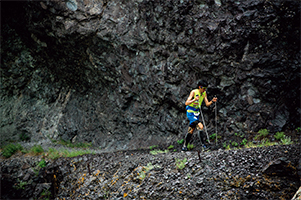
一晩中、後ろの選手のヘッドライトだけがほんの少し視界に入って、あとは自分しかいないっていう状態で山の中を抜けて、目の前にモンブランとグランドジュラス※2がバーンと見える。極限の疲労状態で見た景色は、強烈に脳に刻まれるんです。何十kmと山と格闘してきたことが、尚更あの景色を美しくする。それが、このスポーツの楽しみなんじゃないのかな」
ただでさえ少ない体脂肪が、100マイルを走り終えた頃にはさらに削られている。想像すらできないほど過酷な状況で発見する世界は、恐らく、想像すらできないほど美しい。
ただでさえ少ない体脂肪が、100マイルを走り終えた頃にはさらに削られている。想像すらできないほど過酷な状況で発見する世界は、恐らく、想像すらできないほど美しい。
You run through the mountain all through the night, alone, with only the headlamp light of the runner behind you barely visible. The power of Mont Blanc and Grandes Jorasses coming into view and the scenery you are presented with when running at your upmost conditions will engrave itself into your mind. Running countless kilometers in a battle with the mountain makes the view more beautiful. That is one of the joys of this sport.”
The already barely any body fat condition is even more depleted at the end of the 100mile race. The beauty of the world you encounter within unimaginable extreme conditions is in itself, almost unimaginable.
The already barely any body fat condition is even more depleted at the end of the 100mile race. The beauty of the world you encounter within unimaginable extreme conditions is in itself, almost unimaginable.

※2
モンブランとグランドジュラス
ウルトラトレイル・デュ・モンブラン(UTMB)での風景のこと。モンブラン周辺のフランス、スイス、イタリアに跨がって行われるレースで、世界一のトレイルランナーを決める大会とも言われる。鏑木さんは、2009年に日本人最高位である3位を記録している。
モンブランとグランドジュラス
ウルトラトレイル・デュ・モンブラン(UTMB)での風景のこと。モンブラン周辺のフランス、スイス、イタリアに跨がって行われるレースで、世界一のトレイルランナーを決める大会とも言われる。鏑木さんは、2009年に日本人最高位である3位を記録している。
※2
Mont Blanc Grandes Jorasses
The scenery from the Ultra-Trail du Mont-Blanc (UTMB). A race that covers the France, Swiss, and Italian Mont Blanc region and also known as the proving ground for the world’s best trail runner. In 2009, Mr. Kaburaki finished 3rd, Japan’s highest ever finish.
Mont Blanc Grandes Jorasses
The scenery from the Ultra-Trail du Mont-Blanc (UTMB). A race that covers the France, Swiss, and Italian Mont Blanc region and also known as the proving ground for the world’s best trail runner. In 2009, Mr. Kaburaki finished 3rd, Japan’s highest ever finish.